
Decentralised Autonomous Organisations
Legal Wrappers and Judicial Precedents


The rise of Decentralised Autonomous Organisations (DAOs) has changed how organisations coordinate in the digital economy, shifting some governance functions from hierarchical management to code-based and community driven processes.[1, 3] The friction between borderless, code-based systems and territorially bounded, person centred legal regimes has driven the use of ‘legal wrappers’, legal entities that connect on-chain governance to established financial and legal systems.[1, 2] As DAOs moved from experimental communities to organisations administering substantial assets, questions of legal recognition, contracting capacity and liability exposure became central for participants and investors.[1, 3]
A DAO legal wrapper is a legal entity used by a decentralised organisation to operate within existing legal systems, providing separate legal personality, limited liability and a more defined tax position.[2] It allows a DAO to interact with traditional financial and legal infrastructure while preserving on-chain governance, including the ability to hold property, enter contracts and limit members’ personal exposure.[2, 4] The global position remains fragmented, with jurisdictions taking different approaches to innovation, supervision and consumer protection.[5, 6]
The Crisis of the Unwrapped DAO: Partnership Liability and Judicial Characterisation
The core legal risk for an unwrapped DAO is that courts or regulators may characterise it as a general partnership or an unincorporated association.[4, 7] Under common law and many civil law systems, an association of persons carrying on a business for profit may be treated as a partnership even if no formal entity was intended.[8, 9] That characterisation can expose participants to joint and several liability, including personal responsibility for organisational debts, torts and regulatory breaches.[5, 10]
Recent US litigation has accelerated this analysis.[11, 12] Courts have shown little appetite for the argument that a DAO is merely ‘software’ and therefore outside person-based legal frameworks.[11, 12] The practical lesson is straightforward: the absence of a legal wrapper does not eliminate legal risk and may increase it.[8, 10]
CFTC v. Ooki DAO
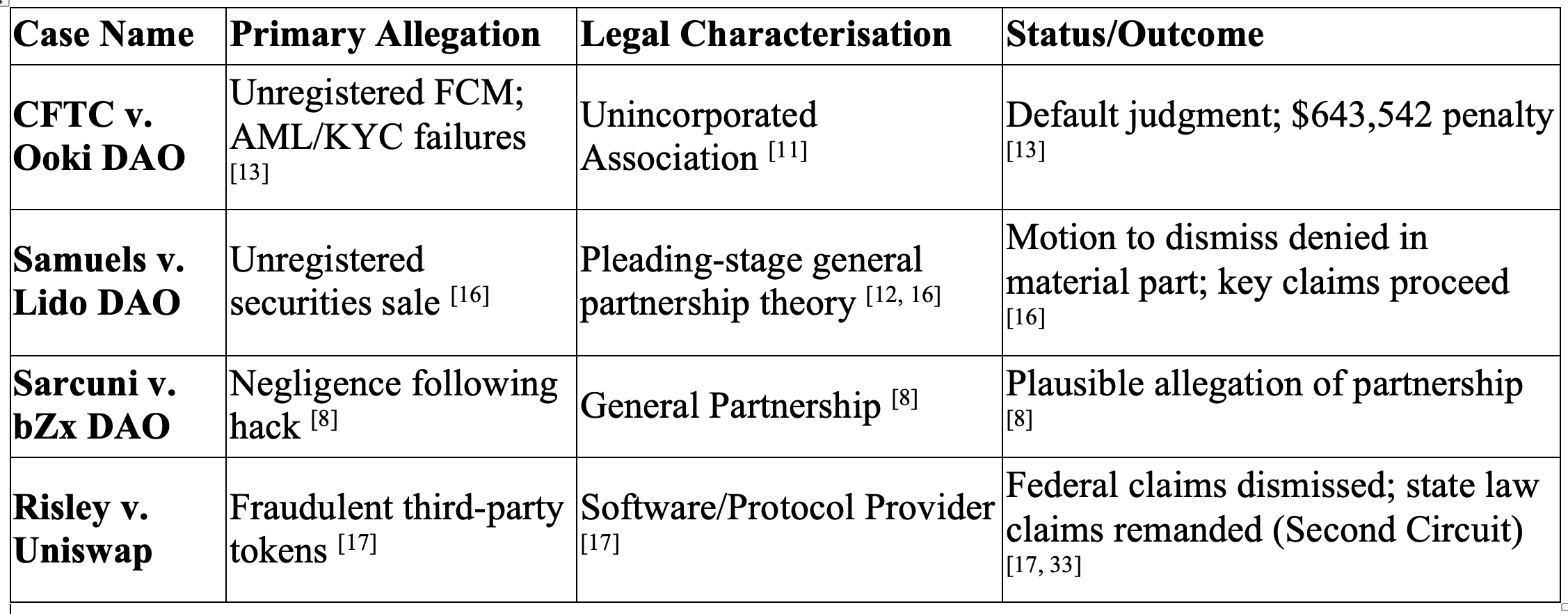
CFTC v. Ooki DAO is a leading authority on a DAO’s capacity to be sued and on the exposure of governance participants.[10, 13] The case arose after bZeroX, LLC transferred protocol control to the bZx DAO (later renamed Ooki DAO), in part to decentralise operations and, on the CFTC’s case, to continue regulated activity through a DAO structure.[8, 10] The CFTC alleged that the DAO operated as an unregistered futures commission merchant and failed to implement required AML and KYC controls.[13, 14]
Service of process was a central procedural issue.[11, 15] Because Ooki DAO had no physical address or registered agent, the CFTC sought service through the DAO’s online forum and help chat box.[11, 15] In earlier service proceedings (later referenced in the default judgment), the court accepted that method as reasonably calculated to provide notice, confirming that a DAO’s digital channels can be used for service in appropriate circumstances.[11, 14] The court also held that Ooki DAO qualified as an unincorporated association under California law.[8, 11] That finding materially increased personal liability risk for governance participants by supporting the theory that voting members may be treated as members of the association for regulatory purposes.[10, 15]
Samuels v. Lido DAO and the Targeting of Governance Participants
The litigation in Samuels v. Lido DAO further develops the pleading stage framework for personal liability in DAO governance.[12, 16] The plaintiff alleges that Lido DAO offered and sold unregistered securities through LDO tokens.[12, 16] At the motion to dismiss stage, the court allowed key claims to proceed and accepted, for pleading purposes, the theory that Lido DAO could be treated as a general partnership under California law.[12, 16] A notable aspect of the ruling is its focus on ‘meaningful participation’, with allegations directed at venture investors including Paradigm, Andreessen Horowitz and Dragonfly based on their governance activity.[9, 16]
The court’s reasoning at that stage referred to factors such as governance rights, proposal activity, voting conduct and public statements suggesting active involvement.[16] The result is a tiered litigation risk profile in which visible or active governance participants may face greater exposure than passive token holders.[16] For venture investors, the case is a reminder that active DAO governance may be relied on by claimants as evidence of partnership style participation where no wrapper exists.[16]
Table 1. Selected DAO litigation examples: allegations, legal characterisation and procedural status.
The Taxonomy of DAO Legal Wrappers
To mitigate these risks, DAOs have adopted a range of wrapper structures designed to provide separate legal personality and to separate organisational liabilities from members’ personal assets.[2, 4] Selecting a wrapper is a strategic legal and operational decision that requires trade offs among cost, regulatory posture, tax treatment and the degree of centralisation needed for execution.[1, 18]
Foundations and Ownerless Entities
Foundation structures, particularly in jurisdictions such as the Cayman Islands, the British Virgin Islands and Switzerland, are widely used for larger token communities.[18, 19] These entities are often described as ‘ownerless’ in the sense that they do not have shareholders or members in the ordinary corporate form.[18, 20] They are instead constituted to pursue a stated purpose, such as protocol stewardship, treasury administration or ecosystem development.[21, 22]
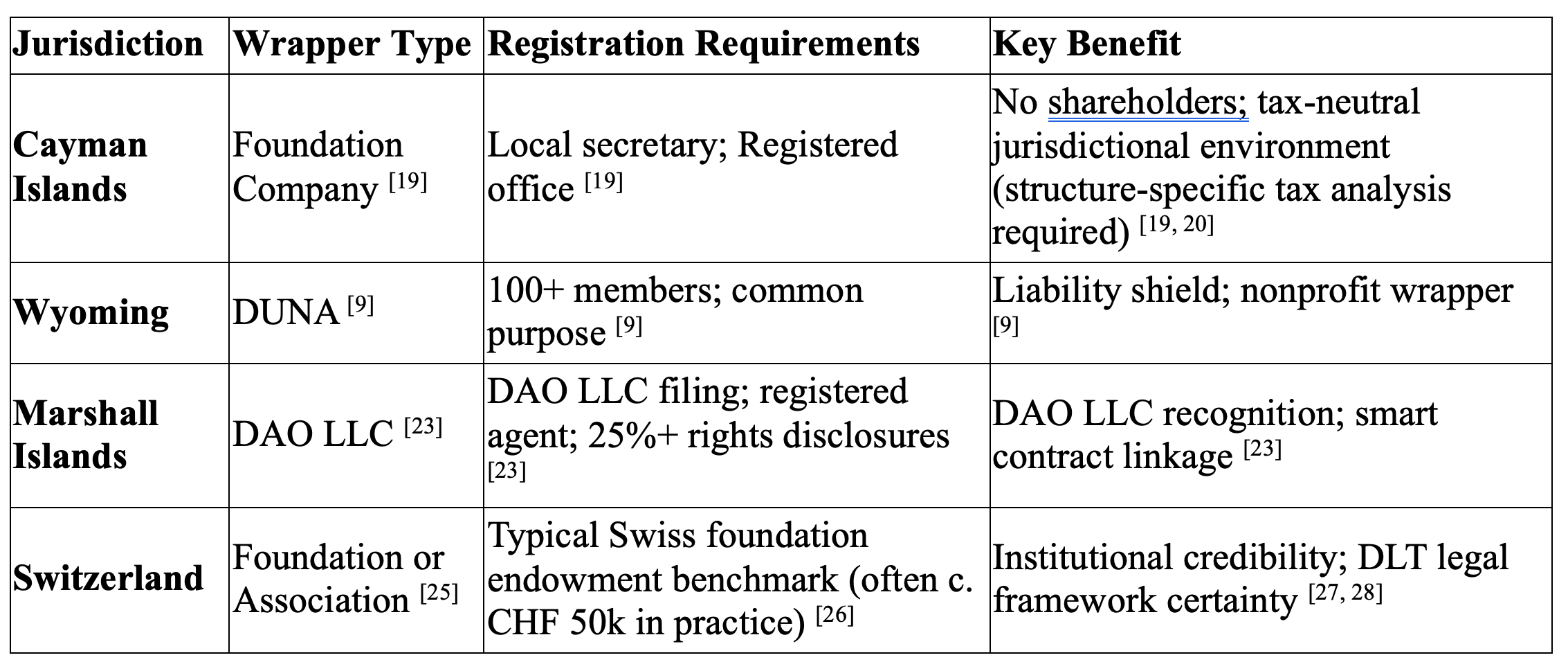
The Cayman Islands Foundation Company (CFC) is often used because it can combine company style governance with purpose driven features.[19, 20] Its constitutional documents can be drafted to recognise on-chain voting outcomes as part of the foundation’s decision making process.[19, 22] Directors or supervisors then act as the execution layer for off-chain functions such as banking, contracting and IP ownership.[20, 21] Used properly, this structure can materially reduce the risk of a general partnership characterisation by providing a clear legal counterparty and liability shield.[18, 19]
Limited Liability Companies (LLCs) and Special Jurisdictions
The LLC model is often used for smaller or more closely held DAOs, including investment groups and service collectives.[1] Although an LLC offers a familiar liability shield, it can introduce identifiable control points that may sit uneasily with a DAO’s decentralisation objectives.[1] Wyoming and the Marshall Islands have both enacted DAO-specific or DAO enabling LLC legislation to bridge that gap.[5, 23, 24]
In the Marshall Islands, the Decentralized Autonomous Organization Act 2022 recognises a DAO LLC as a resident domestic LLC that elects DAO status and links governance to its constitutional documents and, where applicable, smart contracts.[23] The statute allows one or more members, requires a registered agent in the Republic and contemplates both for profit and non-profit DAO LLC structures.[23] It also applies tailored disclosure and reporting rules, including thresholds for significant governance rights, and integrates DAO LLCs into the wider Marshall Islands LLC framework.[23]
Unincorporated Nonprofit Associations (UNAs) and the DUNA Model
The UNA model takes a different route by seeking to avoid the ‘for profit business’ criterion often relied on in implied partnership analysis.[4, 9] By organising as a nonprofit association, a DAO may argue that it lacks the co ownership of a business for profit that commonly underpins partnership findings under state law, including in California.[9] Wyoming’s Decentralised Unincorporated Nonprofit Association (DUNA) Act 2024 is the most developed example of this approach.[9]
The DUNA framework provides several strategic advantages:
• Separate Legal Personality: A DUNA is a legal entity separate from its members for contract and tort purposes, supporting a meaningful liability shield if the statutory requirements are met.[9]
• Nonprofit Form with Permitted Activity: The statute permits revenue generating activity, provided it is pursued in furtherance of the association’s stated nonprofit purpose rather than as a profit distribution vehicle.[9]
• Tax Structuring Flexibility: The framework may improve tax administration and classification planning for some DAOs, but tax outcomes remain fact-specific and require jurisdiction-specific advice rather than assumption.[9]
• Securities Analysis (Not a Safe Harbour): A nonprofit form may assist arguments about token holder expectations and governance rights, but it does not remove securities law risk or displace the Howey analysis.[9]
Table 2. Comparative DAO wrapper jurisdictions: indicative registration features and strategic benefits.
The European and Middle Eastern Regulatory Response
While the United States has tended toward a mix of state level wrapper legislation and federal enforcement activity, several European and Middle Eastern jurisdictions have focused on integrating DLT structures into established legal frameworks.[5, 6, 31]
Switzerland: The Institutional Hub for DLT
Switzerland’s Federal Act on the Adaptation of Federal Legislation to Developments in Distributed Ledger Technology (the DLT Act), which was implemented in stages in 2021, is one of the most developed technology neutral frameworks for integrating DLT into existing federal law.[6, 27] Rather than creating a parallel crypto code, it amends existing legislation across areas including private law, insolvency and financial market infrastructure.[6, 27]
A key feature of the Swiss reforms is the recognition of ledger-based securities, allowing certain rights to be represented and transferred via distributed ledger systems with legal effect under Swiss law.[27, 28] For DAOs, Switzerland commonly presents two practical vehicles: the Swiss Association and the Swiss Foundation.[25] The association is generally more flexible and cost efficient for community led projects, while the foundation is more formal and supervised, and may be preferred where larger treasuries, grant programmes or institutional counterparties are involved.[25, 29]
The UK Law Commission’s Approach
In 2026, the Law Commission of England and Wales published a scoping paper on DAOs and concluded that there was no immediate need for a DAO-specific legal entity in England and Wales.[5] Instead, it recommended reviewing existing frameworks, including the Companies Act 2006 and LLP legislation, to assess how they can better accommodate technology enabled governance.[5] The paper also identified a possible role for a limited liability not for profit association, indicating a cautious but practical reform path-based on adaptation of familiar legal forms rather than creation of a wholly new category.[5]
ADGM and the DLT Foundation Framework
Abu Dhabi Global Market (ADGM) has moved beyond consultation and introduced a bespoke DLT Foundations regime through the Distributed Ledger Technology Foundations Regulations 2023.[31] The framework is designed to provide separate legal personality and a structured registration and governance regime for DLT foundations, including use cases relevant to DAOs and token-based projects.[31] As with other regulated wrappers, the benefits of legal certainty are paired with compliance obligations, including AML and related governance requirements that may not suit anonymous or permissionless community models.[31]
Judicial Disputes in Protocol Liability and Market Manipulation
Beyond wrapper selection, recent disputes have tested the legal responsibility of developers, governance participants and traders in relation to protocol design, third party conduct and market manipulation theories.[17, 35]
Uniswap Labs and the ‘Software Provider’ Defence
Risley v. Uniswap Labs is an important appellate decision on protocol developer liability, but it should not be overstated.[17, 33] Private plaintiffs sought to hold Uniswap Labs and related investors responsible for losses on allegedly fraudulent third party tokens traded via the protocol.[17] The Second Circuit affirmed dismissal of the federal claims, while vacating and remanding aspects of the state law claims for further proceedings.[17, 33] The decision supports the argument that protocol developers are not automatically liable for all third party misuse of open software, while leaving scope for case specific claims depending on pleaded facts and legal theory.[33, 34]
Mango Markets and the Eisenberg ‘Code is Law’ Conflict
Avraham Eisenberg’s exploitation of Mango Markets illustrates the tension between ‘code is law’ narratives and conventional fraud and market manipulation doctrine.[35, 36] Prosecutors alleged that Eisenberg manipulated the price of MNGO related instruments and extracted approximately $110 million in crypto assets from Mango Markets.[35] Although a jury convicted him in 2024, the SDNY later granted Rule 29 relief in part, vacating the commodities fraud and manipulation convictions on venue grounds and entering a judgment of acquittal on the wire fraud count for insufficient evidence.[35] The decision shows that DeFi prosecutions still turn on orthodox criminal law requirements such as venue and proof of misrepresentation, even where the underlying platform is permissionless.[35, 36]
Strategic Insights for Global Structuring
The global market for DAO wrappers is moving from informal experimentation toward more explicit legal structuring.[1, 18, 30] Cases such as Ooki and Lido show that an unwrapped DAO can face ordinary partnership or association analysis, with potentially serious personal liability consequences for active participants.[10, 11, 12, 16]
The Evolution of the ‘Orphan’ Entity
Purpose-based foundation structures in jurisdictions such as Cayman and Switzerland remain a common solution for large token communities.[1, 20] By removing shareholder ownership and introducing a legal counterparty, these entities can preserve decentralised governance at the protocol layer while supporting contracting, treasury management and compliance at the legal layer.[19, 21] They also introduce administrative burdens, including governance formalities, local service providers and, in some cases, KYC obligations, which may be difficult for highly decentralised communities to accept.[1, 29]
Functional Equivalence and the Future of Regulation
The longer term regulatory question is whether legal systems will increasingly accept functional equivalence, as reflected in initiatives such as the COALA Model Law.[37, 38] The underlying proposition is that some blockchain features, including transparency and immutability, may achieve policy objectives similar to parts of conventional corporate compliance frameworks.[37, 39] If that approach gains wider acceptance, wrappers may become more streamlined, but they are unlikely to disappear in the near term given contracting, enforcement and jurisdictional realities.[37, 38]
Tax Neutrality and International Private Law
As DAOs operate across borders, conflict of laws issues, including the lex situs of digital assets, remain difficult and commercially significant.[40, 41] The UK Law Commission’s work on digital assets, including the proposal for a third category of personal property, is an important step toward greater legal certainty in cross border disputes and transactions.[41] For now, many projects continue to use tax neutral or tax efficient jurisdictions for treasury and governance structures, while monitoring changes in international tax and regulatory standards.[19, 42]
Synthesis and Conclusion
The current DAO legal landscape is developing along two tracks.[1, 30] Courts and regulators continue to apply existing partnership, association and enforcement doctrines where no clear legal structure is present.[8, 10, 11, 13] At the same time, some jurisdictions are building workable legal vehicles that allow DAO linked projects to operate with greater certainty.[23, 31]
For advisers, jurisdiction selection is no longer a one-off branding exercise but a risk-based structuring decision tied to the DAO’s governance model, treasury profile, user base and operating footprint.[1] A layered structure can be appropriate in some cases, for example a governance facing foundation combined with separate operating entities for specific activities or geographies.[1] As legal frameworks mature, the wrapper is likely to remain a practical interface between decentralised governance and the legal system, even if its form becomes more specialised.[2, 3, 37]
The move from informal online coordination to legally structured operation need not amount to abandonment of decentralisation.[1, 7] For many projects, a wrapper is simply the mechanism that enables contracting, limited liability and regulatory engagement at scale.[2, 29] The durability of DAO models will depend not only on protocol design, but also on the quality of their legal architecture.[1, 3]
1. Coincub, “DAO Legal Wrappers Playbook.” https://coincub.com/blog/dao-legal-wrappers/
2. Legal Nodes, “DAO Legal Wrappers: Definition, Types, Jurisdictions and Use Cases.” https://legalnodes.com/article/dao-legal-wrapper
3. Law Commission of England and Wales, “Decentralised Autonomous Organisations (DAOs)” project page. https://lawcom.gov.uk/project/decentralised-autonomous-organisations-daos/
4. Legal Nodes, “Choose a Crypto-Friendly Country for a DAO.” https://legalnodes.com/article/choose-a-crypto-friendly-country-for-dao
5. Law Commission of England and Wales, “Decentralised Autonomous Organisations (DAOs): Scoping paper” (project publication page / paper). https://lawcom.gov.uk/project/decentralised-autonomous-organisations-daos/
6. Swiss State Secretariat for International Finance (SIF), “DLT / blockchain / tokenisation.” https://www.sif.admin.ch/en/dlt-blockchain-en
7. O’Melveny, “Decentralized Autonomous Organizations (DAOs): Overview.” https://www.omm.com/insights/alerts-publications/
8. Fenwick, “The Legal Landscape for DAOs: Key Lessons from Lido DAO and Ooki DAO.” https://www.fenwick.com/insights/publications/the-legal-landscape-for-daos-key-lessons-from-lido-dao-and-ooki-dao
9. Wyoming Legislature, Wyoming Decentralized Unincorporated Nonprofit Association Act (DUNA), Wyo. Stat. Title 17, Ch. 32. https://wyoleg.gov/Legislation/Statutes
10. Hodder Law, “CFTC and DAO Regulation / Ooki DAO case commentary.” https://hodder.law/cftc-ooki-dao-regulation/
11. Davis Wright Tremaine, Financial Services Law Advisor, DAO/CFTC litigation commentary (Ooki DAO). https://www.dwt.com/blogs/financial-services-law-advisor/2023/01/dao-cftc-digital-assets-blockchain-lawsuits
12. Davis Wright Tremaine, “Samuels v. Lido DAO: A Potential New Frontier for Liability in the Cryptocurrency Space.” https://www.dwt.com/blogs/financial-services-law-advisor/2025/01/lido-dao-crypto-liability-california-court-case
13. Commodity Futures Trading Commission, Press Release No. 8714-23 (Ooki DAO litigation / enforcement update). https://www.cftc.gov/PressRoom/PressReleases/8714-23
14. CourtListener docket, Commodity Futures Trading Commission v. Ooki DAO, No. 3:22-cv-05416 (N.D. Cal.). https://www.courtlistener.com/docket/65369411/commodity-futures-trading-commission-v-ooki-dao/
15. CourtListener docket entries and judgment materials, Commodity Futures Trading Commission v. Ooki DAO, No. 3:22-cv-05416 (N.D. Cal.). https://www.courtlistener.com/docket/65369411/commodity-futures-trading-commission-v-ooki-dao/
16. Practical Law (Thomson Reuters), Samuels v. Lido DAO case update (subscription source). https://uk.practicallaw.thomsonreuters.com/
17. Risley v. Universal Navigation Inc. (Uniswap), U.S. Court of Appeals for the Second Circuit (summary order / docket materials via CourtListener). https://storage.courtlistener.com/
18. Wyoming Legislature, Wyoming DAO Supplement (DAO LLC), Wyo. Stat. Title 17, Ch. 31. https://wyoleg.gov/Legislation/Statutes
19. Cayman Islands, Foundation Companies Act (as revised) (official legislation / official hosted text). https://www.cima.ky/upimages/commonfiles/FoundationCompaniesAct2017_1737729600.PDF
20. Collas Crill, “Cayman Islands foundation companies … Web3 innovation” (foundation company structuring commentary). https://www.collascrill.com/articles/
21. HCS Offshore Services Ltd., “Cayman Islands Foundation Companies and DAOs” (white paper).
22. Legal Nodes, “Caymanian Foundation for DAO.” https://www.legalnodes.com/article/caymanian-foundation-for-dao
23. Republic of the Marshall Islands, Decentralized Autonomous Organization Act 2022 (Public Law 2022-50). https://rmicourts.org/wp-content/uploads/2022/12/PL-2022-50-Decentralized-Autonomous.pdf
24. Stinson LLP, “Decentralized Autonomous Organization Laws Across the U.S.” https://www.stinson.com/newsroom-publications-DAO-laws-across-the-US
25. Vectra Advisors, “Understanding DAOs and Legal Wrappers in Switzerland.” https://www.vectraadvisors.com/blog/understanding-daos-and-legal-wrappers-in-switzerland
26. Pontinova Law, “Switzerland Foundation” / DAO structuring note. https://www.pontinova.law/dao/switzerland-foundation
27. Swiss Federal Council / Swiss federal authorities, DLT legislative framework information (incl. implementation news). https://www.news.admin.ch/en/nsb?id=84035
28. Swiss Code of Obligations (Fedlex; see Art. 973d et seq. on ledger-based securities) and related Fedlex materials. https://www.fedlex.admin.ch/eli/cc/27/317_321_377/en
29. DAOBox Docs, “Swiss Foundation as a DAO Legal Wrapper - Complete Guide.” https://docs.daobox.io/international/swiss-foundation-as-a-dao-legal-wrapper-complete-guide
30. Oxford University Press, Capital Markets Law Journal, “Decentralized autonomous organizations: adapting legal structures to fit new digital environments” (2025). https://academic.oup.com/cmlj/article/20/3/kmaf011/8249442
31. ADGM, Distributed Ledger Technology Foundations Regulations 2023 (official ADGM/Thomson Reuters rulebook page). https://en.adgm.thomsonreuters.com/rulebook/distributed-ledger-technology-foundations-regulations-2023
32. Uniswap Labs blog, “A Win for DeFi” (SEC investigation closure announcement). https://blog.uniswap.org/a-win-for-defi
33. Holland & Knight / media coverage note on Second Circuit Uniswap-related ruling. https://www.hklaw.com/en/news/intheheadlines/
34. Columbia Law School Blue Sky Blog, “Uniswap’s Reprieve Reveals the Uncertainty of DeFi Regulation.” https://clsbluesky.law.columbia.edu/2025/03/13/uniswaps-reprieve-reveals-the-uncertainty-of-defi-regulation/
35. United States v. Avraham Eisenberg, No. 23-cr-10 (S.D.N.Y.), Opinion and Order (23 May 2025). https://nysd.uscourts.gov/sites/default/files/2025-05/23cr10%20Opinion%20and%20Order.pdf
36. TRM Labs, commentary on the Eisenberg / Mango Markets decision. https://www.trmlabs.com/post/
37. COALA, “The DAO Model Law” (Medium publication). https://medium.com/coala/the-dao-model-law-68e5360971ea
38. UNIDROIT, Digital Assets and Private Law project materials (institutional comparator; not a DAO-specific model law). https://www.unidroit.org/work-in-progress/digital-assets-and-private-law/
39. UNCITRAL / UN General Assembly working document A/CN.9/1225 (DAO-related/private law digital issues reference). https://docs.un.org/en/A/CN.9/1225
40. Law Commission of England and Wales, “Digital assets and electronic trade documents in private international law” project page. https://lawcom.gov.uk/project/digital-assets-and-electronic-trade-documents-in-private-international-law/
41. Law Commission of England and Wales, “Digital assets” project page. https://lawcom.gov.uk/project/digital-assets/
42. Bedell Cristin, “Foundation Companies as DAOs.” https://www.bedellcristin.com/knowledge/briefings/fy-2223/foundation-companies-as-daos/