
Artificial Intelligence and Additive Manufacturing: Reshaping Construction Litigation and Arbitration
Navigating 3D Printing, Liability Frameworks and Global Regulatory Evolution

The construction industry has historically operated as a high-stakes, low-margin sector where technological adoption follows a trajectory of cautious pragmatism. However, the period between 2021 and 2026 represents a departure from this traditional path, as the integration of Artificial Intelligence (AI) and 3D printing (3DP) has fundamentally altered the risk profiles of major infrastructure and residential projects globally. This transformation is not merely operational; it has permeated the legal foundations of the industry, giving rise to new forms of litigation and arbitration that challenge established doctrines of professional negligence, design liability, and procedural due process. As project data volumes explode and autonomous systems begin to occupy roles once held by licensed professionals, the legal community is grappling with the “liability squeeze” that occurs when traditional contracts fail to account for the nuances of machine-generated errors and the complexities of additive manufacturing.[1, 2]
The Emergence of Procedural AI in Construction Disputes
The first significant wave of litigation and arbitration involving AI in construction has not originated from structural collapses caused by algorithms, but from the procedural use of AI within the dispute resolution process itself. Construction disputes are notoriously data-heavy, often involving millions of project emails, complex schedules and thousands of change orders.[3, 4] In the last five years, AI has transitioned from a backend tool for e-discovery to a front-facing participant in the adjudication of claims. The year 2025 is noted as the first full year where applied generative AI became a standard fixture in handling complex construction dispute cases, enabling legal teams to process 100,000 emails in under a week - a task that previously required seven weeks and hundreds of thousands of dollars in manual legal labour.[4, 5]
However, this efficiency has introduced a new class of litigation: sanctions for the misuse of AI in court filings. The case of Noland v. Land of the Free, L.P. illustrates the growing judicial intolerance for “AI hallucinations,” where a lawyer was sanctioned $10,000 for filing appellate briefs containing fabricated case citations generated by ChatGPT.[6] Such incidents have prompted a global regulatory response, with over 39 federal judges in the United States and various international bodies, such as the Dubai International Arbitration Centre (DIAC), issuing standing orders that require the disclosure of AI use and rigorous human verification of all AI-generated content.[6, 7]
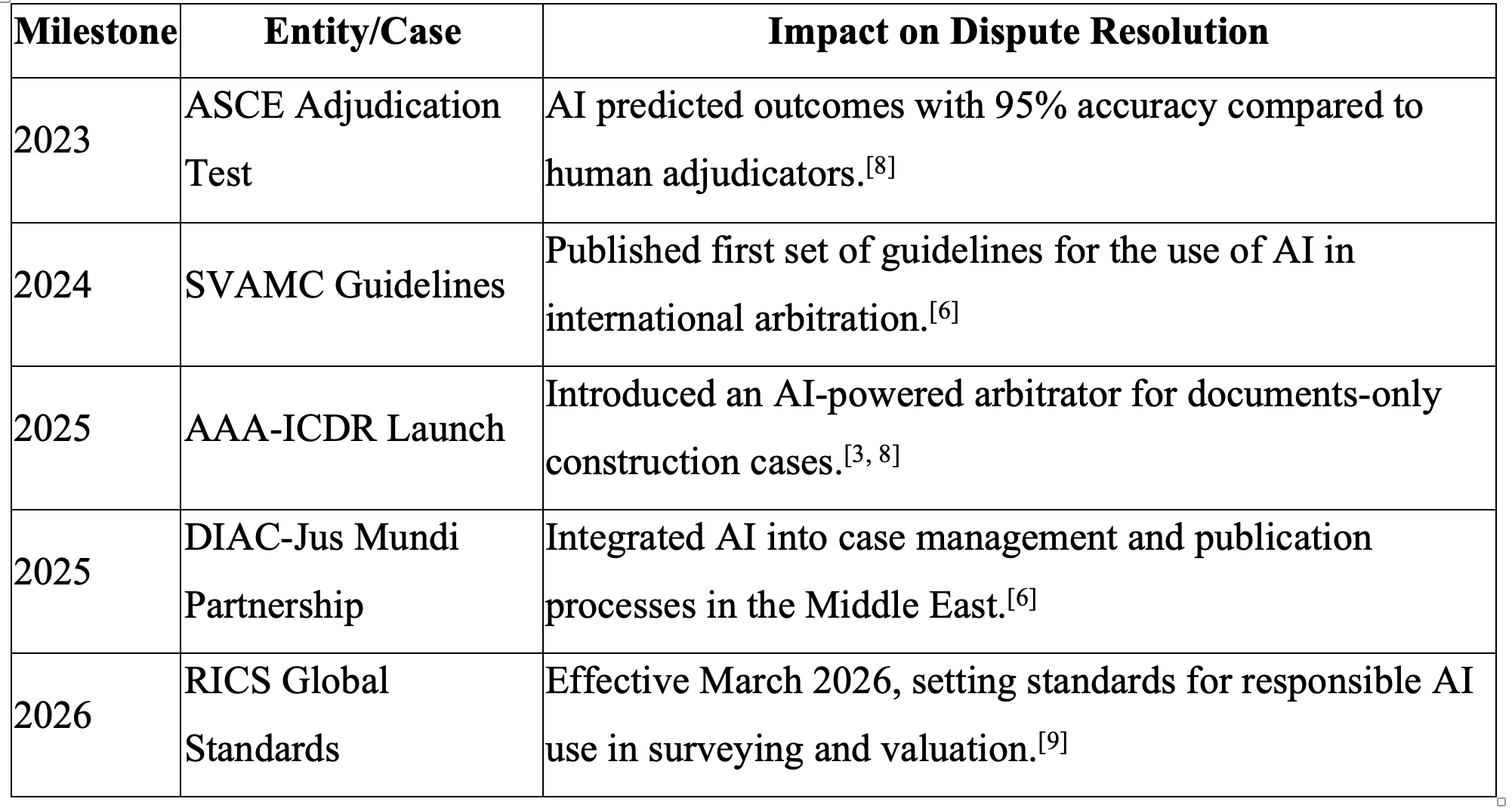
The launch of the AAA-ICDR AI-based arbitrator in November 2025 represents a paradigm shift in construction arbitration. Trained on more than 1,500 construction awards, the system delivers draft awards for low-to-mid-value, two-party disputes.[6, 10] While this “human-in-the-loop” model maintains a requirement for a human arbitrator to validate and sign the final award, it has raised profound questions regarding the enforceability of such decisions under the New York Convention. Critics argue that the delegation of decisional mandates to an algorithm could be viewed as arbitrator misconduct or a violation of the tribunal’s proper constitution, potentially leading to the vacatur of awards in jurisdictions that require human adjudication.[10]
Substantive Liability and the Professional Standard of Care
As AI moves beyond procedural support and into the realm of design and project management, the industry is witnessing the emergence of substantive liability claims. These disputes centre on the question of who bears responsibility when an AI-driven tool produces a flawed output that results in physical failure or financial loss. Traditional construction law defines the standard of care for architects and engineers as the “reasonable care and competence” ordinarily exercised by peers in good standing in the same locality.[11] However, the proliferation of AI-enabled design and monitoring tools is rapidly blurring the line between this simple peer comparison and the “state of the art” standard found in product liability law.[11]
The Shift from Reasonable Care to State of the Art
In 2025 and 2026, the gap between what is technically feasible and what is required for “reasonable competence” has begun to close. A design professional who refuses to utilise AI-powered tools for clash detection or structural optimisation may soon be viewed as ignoring practical tools that improve safety, potentially exposing them to negligence claims.[11]
Conversely, the “unverified reliance” on AI outputs is becoming a primary driver of professional indemnity claims.[1] If an architect follows a generative design system’s proposal for a structurally unsound layout in good faith, the liability will likely still reside with the professional for failing to exercise the requisite oversight, rather than with the software provider, who often disclaims all warranties through restrictive licensing agreements.[1, 12]
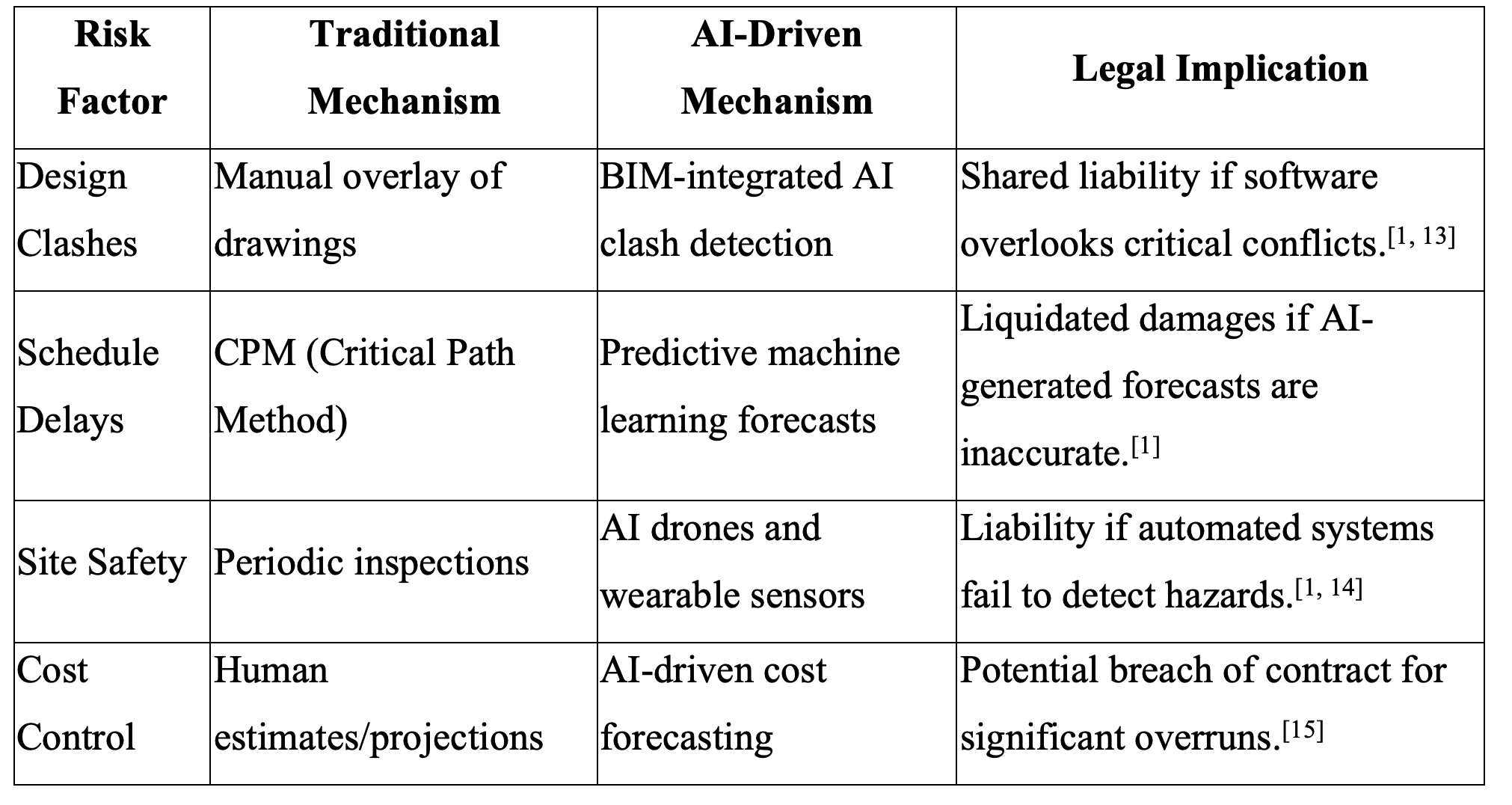
The legal implications are particularly severe in projects utilising Building Information Modelling (BIM) and digital twins. BIM functions as a “digital rehearsal” of the construction process, but when protocols for data ownership and modification are unclear, disputes erupt over “blurred lines of responsibility”.[13, 16] In the US, the Spearin Doctrine, which traditionally implies a warranty of design adequacy from the owner to the contractor, may be compromised in a collaborative BIM environment where contractors and suppliers contribute data to a shared model.[16, 17] In such cases, the contractor might lose the protection of the Spearin Doctrine if they are seen as co-creators of the flawed digital design.[16]
3D Printing in Construction: Case Studies in Failure and Litigation
The application of 3D printing in construction (3DCP) has moved from experimental pilots to commercial reality, but it has not been without significant technical and legal setbacks. The last five years have seen the first major instances of structural failure and subsequent litigation or arbitration related to additive manufacturing.
The Iowa Demolition: A Case Study in PSI Deficiency
In 2023, a project in Muscatine, Iowa, intended to produce ten 3D-printed homes, faced a major failure when the first completed structure failed to meet the required compressive strength standards.[18, 19] Although the material mixture, which included hempcrete, met laboratory requirements, the on-site execution resulted in a failure consistently to reach the minimum threshold needed for structural safety.[18, 19]
This incident highlights several emerging litigation themes in 3DCP:
1. Material Performance Discrepancies: The disconnect between laboratory testing and on-site performance of proprietary cementitious mixtures creates significant risk for contractors and material suppliers.[19]
2. Contractual Absorption of Costs: In the Iowa case, the subcontractor, Alquist 3D, absorbed the costs of the demolition and reconstruction.[19] This “private resolution” is common in the current stage of the industry, as pioneers seek to avoid public litigation that might damage the reputation of the technology.
3. Mechanical and Environmental Delays: 3D printing is sensitive to weather conditions; delays can cause problems with “interlayer bonding” if one layer hardens before the next is laid.[17, 20] This “delamination” is a frequent subject of arbitration claims regarding long-term structural durability.[17]
Arbitration and Structural Performance Failures
Beyond total demolitions, arbitration has become the preferred mechanism for resolving structural integrity issues in US 3D-printed housing projects. Common disputes involve “load-bearing or seismic-resistance failures” and “non-compliance with local building codes”.[17] Arbitrators in these cases are increasingly relying on traditional principles, such as the economic-loss doctrine and the Spearin Doctrine, but adapting them to “hybrid responsibility models” where designers, software providers, and robotics operators all play a role in the construction process.[17]
Intellectual Property Litigation in the 3D Printing Sector
The rise of 3D printing has also triggered a surge in intellectual property (IP) litigation, particularly between established hardware manufacturers and newer market entrants. The rapid evolution of the technology has outpaced the ability of some companies to secure traditional patent protection, leading to claims of design theft and unauthorised replication.
The Stratasys v. Bambu Lab Conflict
In 2024, the US-based company Stratasys filed a landmark claim against China-based Bambu Lab, alleging the infringement of several patents related to 3D printing hardware.[21] The patents in question - covering purge towers, heated build platforms and sensor-based bed mapping - are fundamental to the accuracy and efficiency required for large-scale construction printing.[21] This case underscores the “IP theft window,” where the average 2.4-year duration of patent litigation allows a competitor to replicate a design and refine it before a trial can even begin.[21]
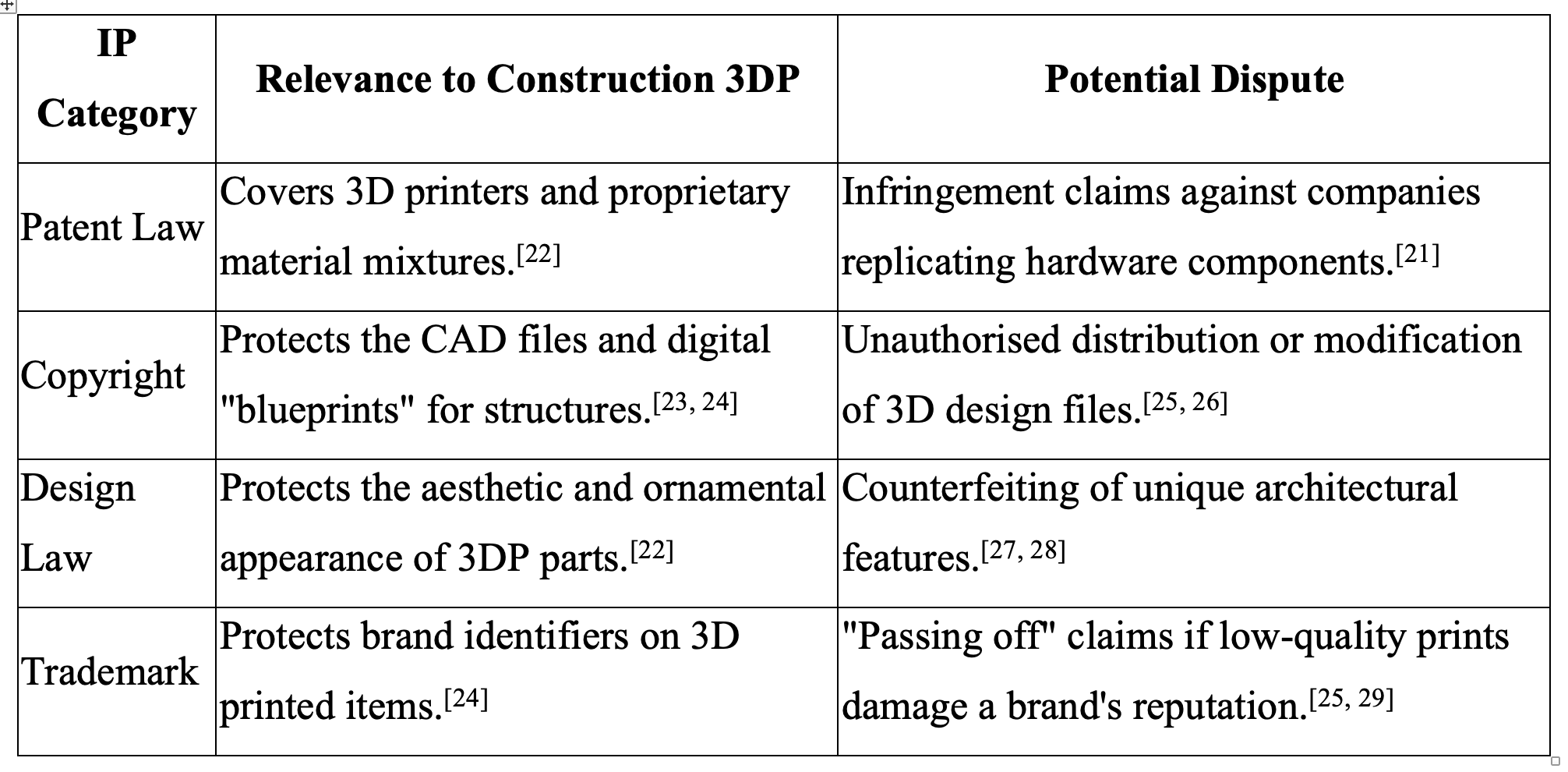
The democratisation of manufacturing through 3DP has also raised concerns regarding the “right to repair.” In the EU, directives on spare parts are impacting how companies protect their IP for 3D-printed components, potentially allowing for the unauthorised printing of spare parts for construction machinery under certain conditions.[25, 27] This creates a tension between patent holders and third-party 3DP services that manufacturers must navigate through complex licensing models.[27]
Global Regulatory Trends: EU, China, and the US (2025–2026)
The regulatory landscape for AI and 3DP in construction is currently undergoing a massive transformation, with major frameworks coming into force.
The EU AI Act and High-Risk Infrastructure
The European Union’s AI Act, which became law in late 2024, classifies AI used in “critical infrastructure” as high-risk.[30, 31] This has immediate implications for construction projects involving energy grids, transportation networks, and public buildings.
• Prohibited Systems (February 2025): Systems that manipulate human behaviour or exploit vulnerabilities are strictly banned.[32, 33] This could apply to AI-driven labour monitoring tools that use subliminal techniques to influence worker productivity on jobsites.[32]
• High-Risk Obligations (August 2026): Providers of AI systems for critical infrastructure must conduct mandatory “conformity assessments,” implement robust human oversight, and ensure the use of high-quality datasets to prevent algorithmic bias.[30, 34, 35]
China’s “AI Plus” and Cybersecurity Frameworks
China has adopted a state-led approach to AI integration, through the “AI Plus Action Plan” issued in August 2025.[36] The goal is to achieve 70% AI penetration in key industrial sectors, including construction and manufacturing, by 2027.[36] However, this is coupled with rigorous cybersecurity amendments, effective January 1, 2026, which expand the state’s reach to “extraterritorial” cyber activities that endanger China’s network security.[37, 38] For international firms, this means that failures in AI governance on projects in China could lead not only to civil litigation but to significant administrative fines and “app closure powers” by regulators.[37]
US National Defence and Procurement Restrictions
In the United States, the 2026 National Defense Authorization Act (NDAA) has introduced a major shift by treating 3D printing as “strategically sensitive infrastructure”.[39, 40] Section 849 of the Act prohibits the Department of Defense from procuring 3D printers from companies linked to China, Russia, Iran, or North Korea.[40] This national security-based vetting process is reshaping the competitive landscape for construction technology, forcing defence contractors to audit their entire supply chains for “covered additive manufacturing machines”.[39, 40]
Contractual Evolution: FIDIC, NEC4, and AI-Specific Clauses
Standard form contracts, which are the backbone of the international construction industry, are currently being rewritten to handle the risks of AI and 3DP. The consensus among drafters is that “contracts don’t deliver projects; people do,” but the presence of AI as a decision-maker requires explicit contractual recognition.[1, 41]
NEC4 and the Spirit of Collaboration
The NEC4 suite of contracts, particularly in jurisdictions like Hong Kong and the UK, is being updated with Z-clauses that focus on “disclosure obligations” and “data ownership”.[12, 42]
• Disclosure of AI Use: Contractors are increasingly required to reveal whether, where, and how AI is used in the delivery of services.[12]
• Data Integrity Warranties: New clauses include warranties that AI systems have been trained on “representative and appropriately curated datasets” to guard against biased outcomes.[43]
• Early Warning Systems: The NEC4 “early warning” mechanism is being leveraged to report potential AI malfunctions or “model drift” before they lead to project defects.[43, 44]
FIDIC and the Future of the “Engineer”
The FIDIC 2025 conference in London highlighted the “Engineers’ accountability” in the age of AI.[41, 45] A central debate is whether FIDIC should adopt AI into its multi-tiered dispute resolution mechanism. While some advocate for an “AI tier” before the Dispute Adjudication and Avoidance Board (DAAB) stage, others remain wary of the “black box” nature of algorithmic determinations.[41, 46] FIDIC is currently urging the industry to include basic principles in contracts to begin measuring and monitoring AI performance, even without the immediate introduction of liquidated damages for AI failure.[41, 45]
Insurance Market Reactions: Exclusions and “Silent AI”
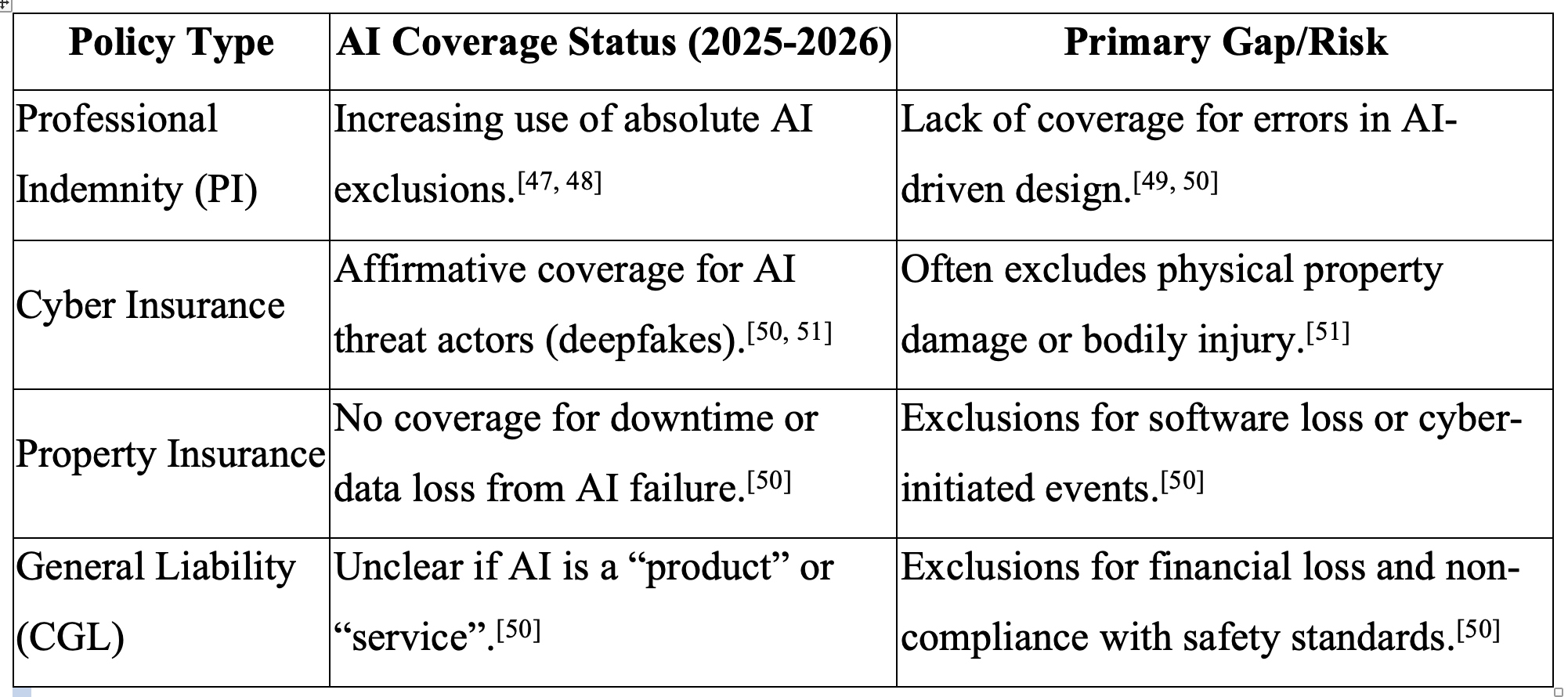
The insurance industry is currently in a state of “racing to define its risk appetite” for AI in construction.[47] This has led to two distinct trends: the introduction of “absolute” exclusions and the emergence of “Silent AI” risks.
The Proliferation of AI Exclusions
Between 2024 and 2026, major carriers like Berkley and Hamilton Insurance Group introduced broad exclusions for professional liability (PI) and directors and officers (D&O) policies.[47, 48]
• The Berkley Exclusion: An “absolute” exclusion for any claim based upon or arising out of the actual or alleged use, deployment, or development of AI.[47]
• Generative AI Exclusions: Specifically targeting the use of tools like ChatGPT or Midjourney in architectural design, these exclusions remove coverage for any damages or defence costs associated with content generated by these systems.[47]
The Danger of Silent AI
“Silent AI” refers to risks that are neither explicitly included nor excluded in a policy, creating massive ambiguity and potential coverage gaps.[49] For construction firms, this means a structural failure caused by a 3D printer malfunction might be denied under a standard PI policy because it involved an “autonomous system,” but also denied under a property policy due to cyber-related exclusions.[49, 50] The market is currently seeing a small handful of AI-specific products, such as those from Armilla AI, but these rarely cover “bodily injury or property damage,” leaving the most critical construction risks unaddressed.[51]
Conclusion: Strategic Implications for the Global Construction Sector
The evidence from the last five years indicates that the construction industry has entered a “liability squeeze” where the efficiency gains of AI and 3DP are offset by the emergence of novel legal and financial risks. Litigation and arbitration are no longer merely reactive processes but are becoming data-centric environments where the “human-in-the-loop” is a legal requirement for the enforceability of awards and the defence of professional standards.[10, 52]
For contractors and developers, the key takeaways for 2026 and beyond are:
1. Contractual Clarity is Paramount: Relying on standard SaaS or “off-the-shelf” technology agreements is a significant liability. Contracts must explicitly allocate responsibility for AI inaccuracies and define the ownership of “derivative data” generated by project models.[1, 53]
2. The “Spearin” Risk in BIM: The collaborative nature of modern design-build projects using AI-integrated BIM could deprive contractors of traditional defences against design errors. Detailed BIM protocols that define data contribution and approval stages are essential.[16]
3. Vigilance in Insurance Renewals: As carriers introduce broad AI exclusions, firms must engage with brokers to identify “Silent AI” gaps and seek specialised endorsements where necessary.[49, 50]
4. Regulatory Compliance as a Global Strategy: With the EU AI Act and China’s Cybersecurity amendments taking full effect in 2026, international construction firms must adopt a “highest common denominator” approach to AI governance to avoid catastrophic fines.[30, 33, 37]
The “Year of Generative AI” in construction has arrived, but it has brought with it a complex web of litigation, arbitration and regulatory hurdles that will take decades to fully resolve. The industry’s success will depend not on the speed of its machines, but on the sophistication of its legal and risk management frameworks in navigating this unprecedented technological frontier.
--------------------------------------------------------------------------------
1. Who’s Liable When AI Builds? - Area Development, https://www.areadevelopment.com/construction-project-planning/q4-2025/whos-liable-when-ai-builds.shtml
2. AI Vendor Liability Squeeze: Courts Expand Accountability While Contracts Shift Risk, https://www.joneswalker.com/en/insights/blogs/ai-law-blog/ai-vendor-liability-squeeze-courts-expand-accountability-while-contracts-shift-r.html?id=102l4ta
3. How AI Is Changing Construction Disputes at AAA, https://www.adr.org/news-and-insights/ai-in-construction-disputes/
4. Construction Disputes in 2025: The Year of Generative AI | ThinkSet - BRG, https://www.thinkbrg.com/thinkset/construction-disputes-in-2025-the-year-of-generative-ai/
5. Construction Disputes in 2025: The Year of Generative AI is Here, https://www.americanbar.org/groups/construction_industry/resources/under-construction/2026-midwinter/construction-disputes-in-2025-the-year-of-generative-ai-is-here/
6. Courts and governments are still grappling with position of AI in ..., https://www.pinsentmasons.com/out-law/analysis/ai-litigationarbitration-legal-challenges
7. Arbitration group unveils AI tool for construction, https://www.constructiondive.com/news/arbitration-group-unveils-ai-tool-for-construction/805909/
8. Arbitration and AI: From Data Processing to Deepfakes. Outlining the Potential – and Pitfalls, https://www.klgates.com/Arbitration-and-AI-From-Data-Processing-to-Deepfakes-Outlining-the-Potential-and-Pitfalls-of-AI-in-Arbitration-10-27-2025
9. Professional Liability Risks in the Age of Artificial Intelligence | DWF Group, https://dwfgroup.com/en/news-and-insights/insights/2025/9/professional-liability-risks-in-the-age-of-artificial-intelligence
10. International Arbitration Experts Discuss The Use Of An AI Arbitrator ..., https://www.alvarezandmarsal.com/thought-leadership/international-arbitration-experts-discuss-the-use-of-an-ai-arbitrator-for-construction-arbitrations
11. Navigating the AI revolution: Duty of care in modern design | News & Events | Clark Hill PLC, https://www.clarkhill.com/news-events/news/navigating-the-ai-revolution-duty-of-care-in-modern-design/
12. The AI Contract Conundrum Beyond Standard Terms - Bird & Bird, https://www.twobirds.com/en/insights/2025/the-ai-contract-conundrum-beyond-standard-terms
13. Digital Construction: BIM, Smart Contracts, and AI Challenges - Youssef & Partners, https://youssef.law/insights/digital-construction-bim-smart-contracts-ai-challenges/
14. How is AI transforming international construction projects and what legal disputes could follow? - Gowling WLG, https://gowlingwlg.com/en/insights-resources/articles/2025/how-is-ai-transforming-international-construction-projects
15. The Legal Risks of AI in the Homebuilding Industry | Tech Talk | Insights & Events, https://www.bilzin.com/insights/publications/2025/08/the-legal-risks-of-ai-in-homebuilding
16. Legal Considerations Associated with Building Information Modeling, https://caed.calpoly.edu/content/pdci/research-projects/simonian-10
17. Arbitration Involving Disagreements Regarding 3D ... - Law Gratis, https://www.lawgratis.com/blog-detail/arbitration-involving-disagreements-regarding-3d-printed-housing-structural-integrity-issues-in-us-construction-projects
18. Iowa Demolishes Its First 3D Printed House - Hackaday, https://hackaday.com/2023/11/29/iowa-demolishes-its-first-3d-printed-house/
19. Why did Iowa demolish its first 3D printed house? - 3D ADEPT MEDIA, https://3dadept.com/why-did-iowa-demolish-its-first-3d-printed-house/
20. 3D Construction Trends And 3D Concrete Printing | AJG United States - Gallagher Insurance, https://www.ajg.com/news-and-insights/3d-construction-trends-and-3d-concrete-printing/
21. China Is Winning the 3D-Printing Race. Can the US Catch Up? | PCMag, https://www.pcmag.com/opinions/china-is-winning-the-3d-printing-race-can-the-us-catch-back-up
22. 3D printing and IP law - WIPO, https://www.wipo.int/en/web/wipo-magazine/articles/3d-printing-and-ip-law-39896
23. 3D printing and housing: intellectual property and construction law - UQ eSpace, https://espace.library.uq.edu.au/view/UQ:f762d90
24. Intellectual Property Challenges in the Age of 3D Printing: Navigating the Digital Copycat Dilemma - MDPI, https://www.mdpi.com/2076-3417/14/23/11448
25. 3D Printing Technology and Intellectual Property Infringement - Myerson Solicitors, https://www.myerson.co.uk/news-insights-and-events/3d-printing-technology-and-intellectual-property-infringement
26. Implications of 3D Printing in Intellectual Property, https://abounaja.com/blog/3d-printing-and-intellectual-property
27. 3D printing and intellectual property: Essential insights for IP professionals, https://ipbusinessacademy.org/3d-printing-and-intellectual-property-essential-insights-for-ip-professionals
28. Legal challenges of 3D printing | DLA Piper, https://www.dlapiper.com/insights/publications/2015/05/law-a-la-mode-issue-16/legal-challenges-of-3d-printing
29. 3D printing technology and intellectual property infringement - BusinessCloud, https://businesscloud.co.uk/opinion/3d-printing-technology-and-intellectual-property-infringement/
30. Key insights into AI regulations in the EU and the US: navigating the evolving landscape, https://www.kennedyslaw.com/en/thought-leadership/article/2025/key-insights-into-ai-regulations-in-the-eu-and-the-us-navigating-the-evolving-landscape/
31. AI Regulations in 2025: US, EU, UK, Japan, China & More - Anecdotes AI, https://www.anecdotes.ai/learn/ai-regulations-in-2025-us-eu-uk-japan-china-and-more
32. EU AI Act - Updates, Compliance, Training,
https://www.artificial-intelligence-act.com/
33. The First Requirements of the EU AI Act Come into Force in February 2025 | Littler, https://www.littler.com/news-analysis/asap/first-requirements-eu-ai-act-come-force-february-2025
34. High-level summary of the AI Act | EU Artificial Intelligence Act, https://artificialintelligenceact.eu/high-level-summary/
35. The Year in AI Law: 2025’s Biggest Legal Cases and What They Mean for 2026, https://www.internetlawyer-blog.com/the-year-in-ai-law-2025s-biggest-legal-cases-and-what-they-mean-for-2026/
36. Global AI Governance Law and Policy: China - IAPP, https://iapp.org/resources/article/global-ai-governance-china
37. China’s 2025 Cybersecurity Law amendments: Enhanced penalties, expanded extraterritorial application, and AI governance - Linklaters - Tech Insights, https://techinsights.linklaters.com/post/102lrz5/chinas-2025-cybersecurity-law-amendments-enhanced-penalties-expanded-extraterr
38. China Updates Cybersecurity Frameworks to Address AI and Infrastructure Risks, https://www.pearlcohen.com/china-updates-cybersecurity-frameworks-to-address-ai-and-infrastructure-risks/
39. Not a China Ban, but Close: Who the U.S. Military Can (and Can’t) Buy 3D Printers From, https://all3dp.com/4/not-a-china-ban-but-close-who-the-u-s-military-can-and-cant-buy-3d-printers-from/
40. U.S. blocks additive manufacturing systems tied to China, Russia, Iran, and North Korea from defense procurement - 3D Printing Industry, https://3dprintingindustry.com/news/u-s-blocks-additive-manufacturing-systems-tied-to-china-russia-iran-and-north-korea-from-defense-procurement-247868/
41. FIDIC CONTRACTS- HUMAN BEHAVIOURS, AI AND CARBON ..., https://www.bclplaw.com/en-US/events-insights-news/fidic-contracts-human-behaviours-ai-and-carbon-management.html
42. Embracing the NEC spirit: aligning Hong Kong practices for collaborative success | News, https://www.neccontract.com/news/embracing-the-nec-spirit-aligning-hong-kong-practices-for-collaborative-success
43. Eight essential clauses for AI contracts: A guide for vendors and customers in Northern Ireland - A&L Goodbody, https://www.algoodbody.com/insights-publications/eight-essential-clauses-for-ai-contracts-a-guide-for-vendors-and-customers-in-northern-ireland
44. Defects under NEC4 Contracts – summary of key terminology and mechanisms, https://www.sharpepritchard.co.uk/latest-news/defects-under-nec4-contracts-summary-of-key-terminology-and-mechanisms/
45. FIDIC Contracts - Human Behaviours, AI and Carbon Management | BCLP - JDSupra, https://www.jdsupra.com/legalnews/fidic-contracts-human-behaviours-ai-and-6054441/
46. Collaboration, AI, disputes and arbitration all highlighted at contracts conference - FIDIC, https://fidic.org/node/46434
47. AI Update: The Growing Trend of AI-Related Insurance Policy Exclusions | JD Supra, https://www.jdsupra.com/legalnews/ai-update-the-growing-trend-of-ai-3672112/
48. The Continued Proliferation of AI Exclusions - Hunton Andrews Kurth LLP, https://www.hunton.com/hunton-insurance-recovery-blog/the-continued-proliferation-of-ai-exclusions
49. Silent AI cover: the unforeseen risks for insurers - Kennedys Law, https://www.kennedyslaw.com/en/thought-leadership/article/2025/silent-ai-cover-the-unforeseen-risks-for-insurers/
50. Insuring the AI age - WTW, https://www.wtwco.com/en-us/insights/2025/12/insuring-the-ai-age
51. AI exclusions are creeping into insurance - but cyber policies aren’t the issue yet, https://www.insurancebusinessmag.com/us/news/cyber/ai-exclusions-are-creeping-into-insurance--but-cyber-policies-arent-the-issue-yet-560647.aspx
52. Construction professionals: how AI use can impact your PII - Lockton, https://global.lockton.com/gb/en/news-insights/construction-professionals-how-ai-use-can-impact-your-pii
53. The Rise of AI Vendor Agreements: 7 Clauses Every Business Needs to Get Right in 2025, https://holonlaw.com/ai/the-rise-of-ai-vendor-agreements/